
Blog · 18 November 2026 · 5 min read
Why AI research reports get numbers wrong, and how to catch it
Ask an AI assistant for a research report and the numbers usually look right: plausible, precise, nicely formatted. That is exactly why errors in them are easy to miss. In our experience, wrong figures in AI-written reports almost never look wrong. They look like this: "The market grew 14% in 2024." The question is whether that is what the source says.
Here are the five most common ways numbers go wrong, and a quick way to catch each one.
1. The right number from the wrong year
Sources often contain several years of data in one table. A report can pick the correct figure for the wrong year, or present an old figure as if it were current. How to catch it: for every important number, check that the year in the report matches the year in the source, and that the source is recent enough for the topic.
2. The right number in the wrong unit
Millions become billions, percent becomes percentage points, nominal becomes real, monthly becomes annual. These slips change the meaning of a sentence completely while keeping the digits identical. How to catch it: read the unit and the definition around the number in the source, not just the digits.
3. A real number attached to the wrong source
A report may combine information from many pages. Sometimes a correct figure from one page ends up with a citation to another page that never mentions it. The number is real, but you cannot verify it from the link you were given. How to catch it: open the cited source and search it for the exact figure. If it is not there, treat the number as unverified, even if it seems familiar.
4. Rounding and paraphrase drift
"Nearly a third" becomes "about 35%"; "up to 40%" becomes "40%"; "in some regions" disappears. Each step is small, but together they can turn a cautious finding into a strong claim. How to catch it: compare the wording around the number, especially words like "up to", "about", "in some cases" and "projected".
5. Numbers with no source at all
Language models can produce figures that look exactly like real statistics but come from nowhere. They are rarer in tools that search the web, but they still happen, often in summary sections and introductions. How to catch it: any number without a citation next to it should be treated as unverified until you find it in a source yourself.
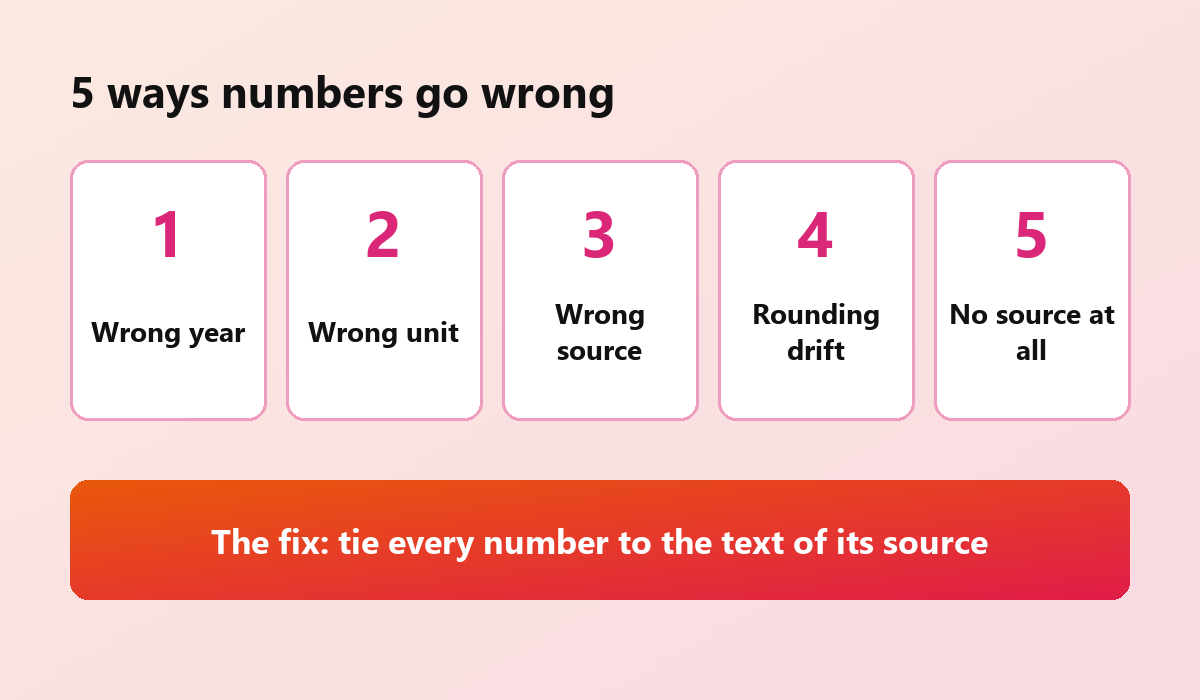
The general fix: tie every number to the text of its source
All five problems have the same remedy. A number in a report should be traceable to a specific passage in a specific source, with the same value, unit and year. If a reader cannot follow that trail, the number should not be stated as fact.
This is the rule we follow in FindDepth. Before a report is delivered, every figure is looked up in the text of the source it cites. Numbers that cannot be found there are left out rather than kept and hoped for. In the two reports on our comparison page, that meant 65 of 65 and 115 of 115 figures found in their cited sources. Every number comes with a source you can open in one click, and our 10-minute checklist shows how to verify the ones that matter most to you.