
Blog · 18 November 2026 · 5 min read
We gave three AI research tools the same question. Here is what came back
"Deep research" now appears in the product name of almost every AI assistant. The reports look similar at first glance: headings, paragraphs, a list of links at the end. The differences only show up when you count what is actually inside them. So we did.
How we compared
- We asked FindDepth, Gemini 4 Argon and ChatGPT 6 Deep Research the same questions, in English, in October 2026.
- We kept each report exactly as delivered, without editing, and counted words, tables, in-text citations and listed sources ourselves from the delivered files.
- "Figures checked" is FindDepth's own automatic check: each number in the report is looked up in the text of the source it cites. The other tools do not report such a check, so we list them as "not reported" rather than guess.
We ran two questions on different subjects. Results differ by question and by run, so read the reports and judge for yourself; all six are linked from the comparison page.
Question 1: How did World War I and World War II change the global order?
| FindDepth | Gemini 4 Argon | ChatGPT 6 Deep Research | |
|---|---|---|---|
| Report length | ≈16,700 words | ≈5,600 words | ≈8,000 words |
| Sources read | 52 | Not reported | Not reported |
| Sources cited | 21 | 41 | 37 |
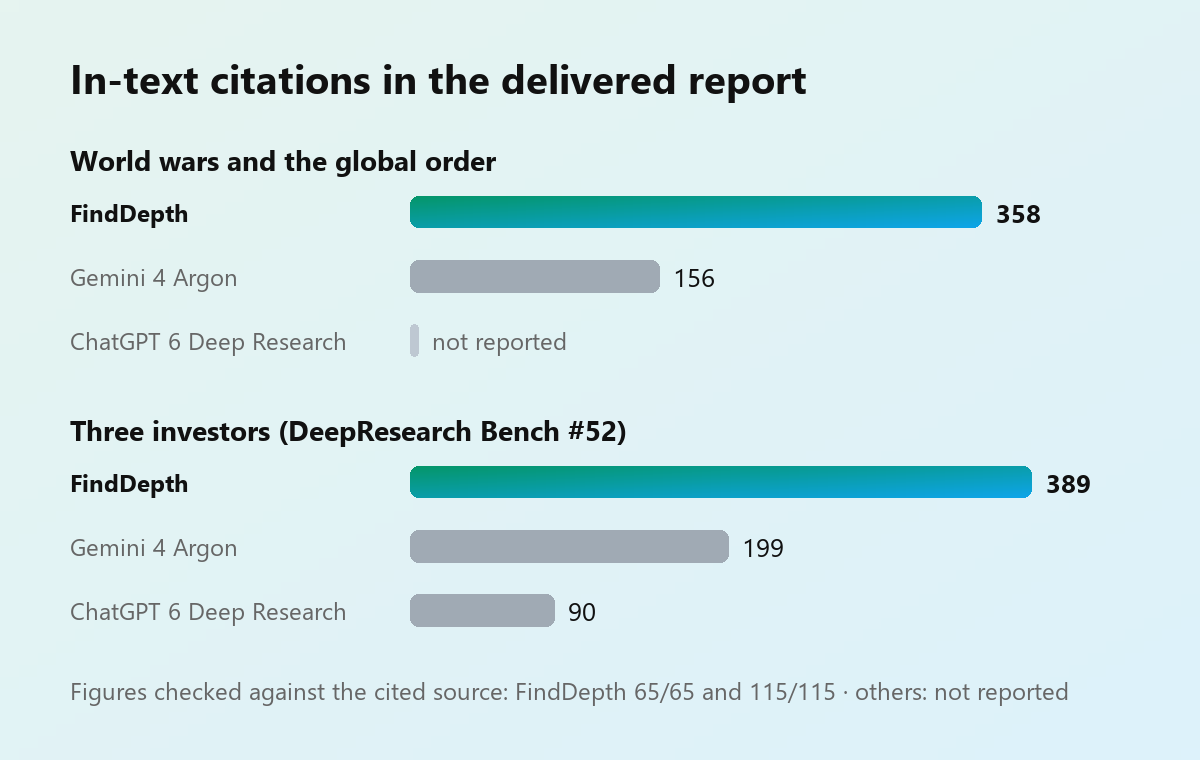
| In-text citations | 358 | 156 | Not reported |
| Tables | 9 | 2 | 2 |
| Figures checked against the cited source | 65 of 65 found | Not reported | Not reported |
| Open questions stated | 5 | None stated | None stated |
Question 2: What are the investment philosophies of Duan Yongping, Warren Buffett and Charlie Munger?
This is question 52 of DeepResearch Bench, a public benchmark. We took it in list order rather than choosing it ourselves.
| FindDepth | Gemini 4 Argon | ChatGPT 6 Deep Research | |
|---|---|---|---|
| Report length | ≈14,600 words | ≈6,500 words | ≈7,900 words |
| Sources read | 56 | Not reported | Not reported |
| Sources cited | 14 | 32 | 29 |
| In-text citations | 389 | 199 | 90 |
| Tables | 8 | 3 | 1 |
| Figures checked against the cited source | 115 of 115 found | Not reported | Not reported |
| Open questions stated | 4 | None stated | None stated |
What the numbers mean, and what they do not
Longer is not automatically better. A 16,000-word report is only useful if the extra length carries evidence. What we looked for was density: how often a statement is tied to a source you can open. On both questions, FindDepth placed about twice as many in-text citations as the nearest tool, or more.
Sources read in full, not just listed. FindDepth read 52 and 56 sources in full and kept the ones that actually support the text. A long reference list at the end says little about how carefully each source was used; in-text citations show it directly, and that is where FindDepth leads.
Checked figures. Every number in both FindDepth reports was found in the text of the source it cites: 65 of 65 and 115 of 115 (FindDepth’s automatic check). The other tools do not show whether their figures were checked. FindDepth does. If numbers matter to your decision, that is the difference that counts.
Speed or certainty? A typical FindDepth research takes 20 to 50 minutes, because every source is read in full and every figure is checked before you see the report. Faster tools are fine for a quick overview. When you need a report you can rely on, that is exactly the difference you are paying for.
Try it on your own question
The fairest test is the one that matters to you. Ask the same question to the tools you use and to FindDepth, then run the 10-minute check on each report.
Gemini and ChatGPT are trademarks of their owners. FindDepth is independent and not affiliated with them.